What is the difference between a Router and a Layer 3 Switch?
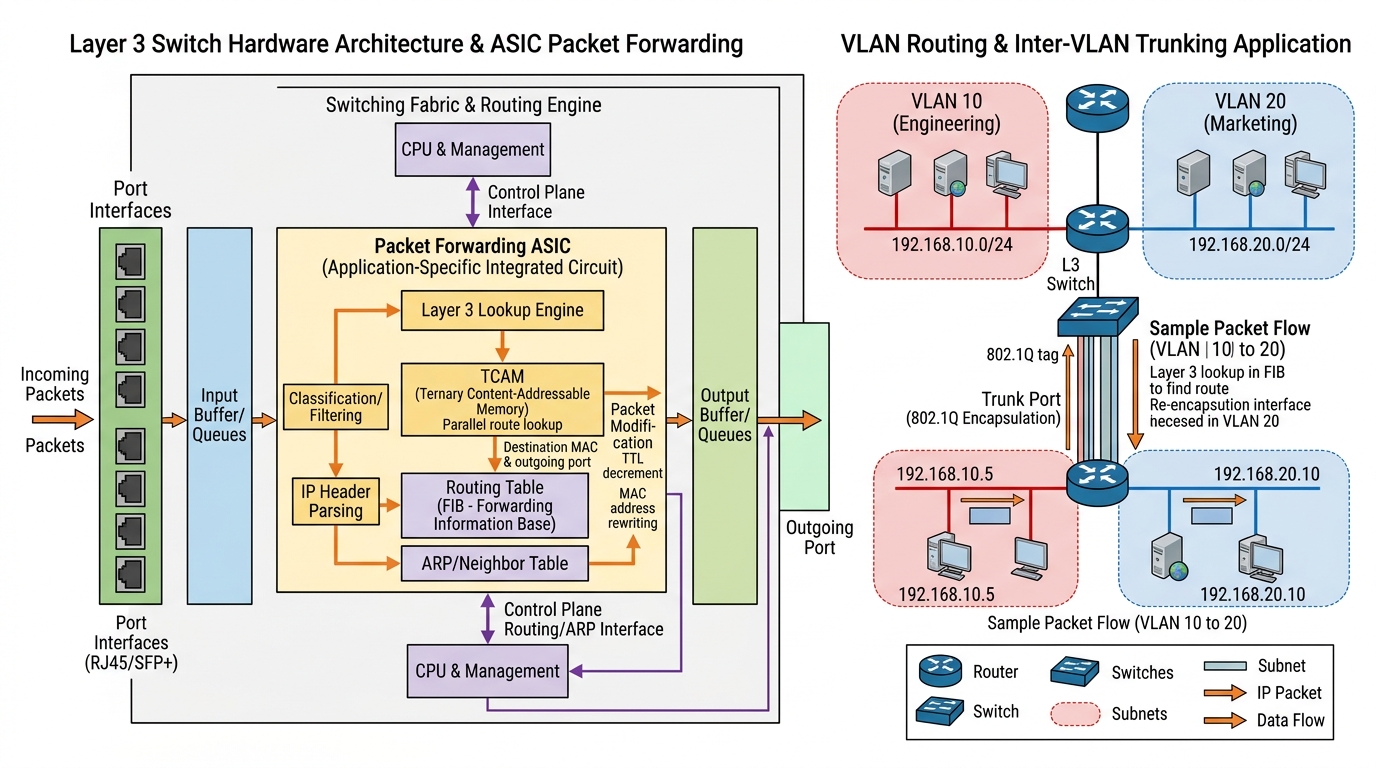
The fundamental difference between a router and a Layer 3 switch is hardware optimization. While both operate at the Network layer (Layer 3) to route packets using IP addresses, Layer 3 switches utilize specialized Application-Specific Integrated Circuits (ASICs) to pass data as fast as Layer 2 switches. This allows Layer 3 switches to process intra-VLAN traffic significantly faster in a Local Area Network (LAN) environment compared to traditional routers, which rely more on software-based processing.
Understanding the OSI Model Context
While most standard network switches operate strictly at the Data Link layer (Layer 2) of the OSI Reference Model—relying on MAC addresses to determine the source and destination of a packet—advanced networks require more intelligent routing capabilities. Some switches incorporate features of a router and operate at the Network layer (Layer 3) as well. In fact, a Layer 3 switch is incredibly similar to a traditional router in terms of functional logic.
When a standard router receives a data packet, it inspects the Layer 3 source and destination IP addresses to determine the optimal path the packet should take across the network. Conversely, a standard switch relies entirely on MAC addresses to determine the localized destination of a packet, which constitutes basic Layer 2 (Data Link) networking.
Hardware Optimization: Why Layer 3 Switches are Faster
Within the LAN environment, a Layer 3 switch is usually much faster than a router because it is built upon high-speed switching hardware. In fact, many enterprise-grade Layer 3 switches—such as those manufactured by Cisco—are effectively routers that operate at line-rate speeds because they are built on "switching" hardware equipped with customized chips (ASICs) inside the chassis.
Dynamic Hardware Reprogramming
The pattern matching and route caching mechanisms on Layer 3 switches are conceptually similar to those on a router. Both utilize a dynamic routing protocol (like OSPF or EIGRP) and a comprehensive routing table to determine the absolute best path for data transit. However, a Layer 3 switch possesses the unique ability to reprogram its hardware dynamically with the current Layer 3 routing information. This architectural advantage is exactly what allows for significantly faster packet processing.
On modern Layer 3 switches, the route information received from various routing protocols is directly used to update the hardware caching tables. Once the initial routing decision is made in software, all subsequent packets in that specific flow are forwarded entirely by the hardware, drastically reducing latency and CPU overhead.
Use Cases: When to Deploy Which
Choosing between a standard router and a Layer 3 switch largely depends on your specific network topology and traffic demands. Layer 3 switches are typically deployed at the core or distribution layer of an enterprise campus network where high-speed inter-VLAN routing is critical. Traditional routers, on the other hand, excel at the network edge where complex WAN (Wide Area Network) connectivity, NAT (Network Address Translation), VPN termination, and advanced firewall capabilities are required.
Frequently Asked Questions (FAQ)
Can a Layer 3 switch completely replace a router?
In a purely LAN environment, a Layer 3 switch can often replace an internal router for high-speed inter-VLAN routing. However, for edge connectivity involving WAN connections, complex NAT, or advanced security features, a traditional router or firewall is still necessary.
Does a Layer 3 switch use MAC addresses?
Yes. A Layer 3 switch performs both Layer 2 and Layer 3 functions. It uses MAC addresses for local subnet switching and IP addresses for routing packets between different subnets or VLANs.
What is an ASIC in network switching?
ASIC stands for Application-Specific Integrated Circuit. In Layer 3 switches, ASICs are specialized silicon chips designed to process routing lookups and forward packets in hardware, making them significantly faster than software-based routing processors.