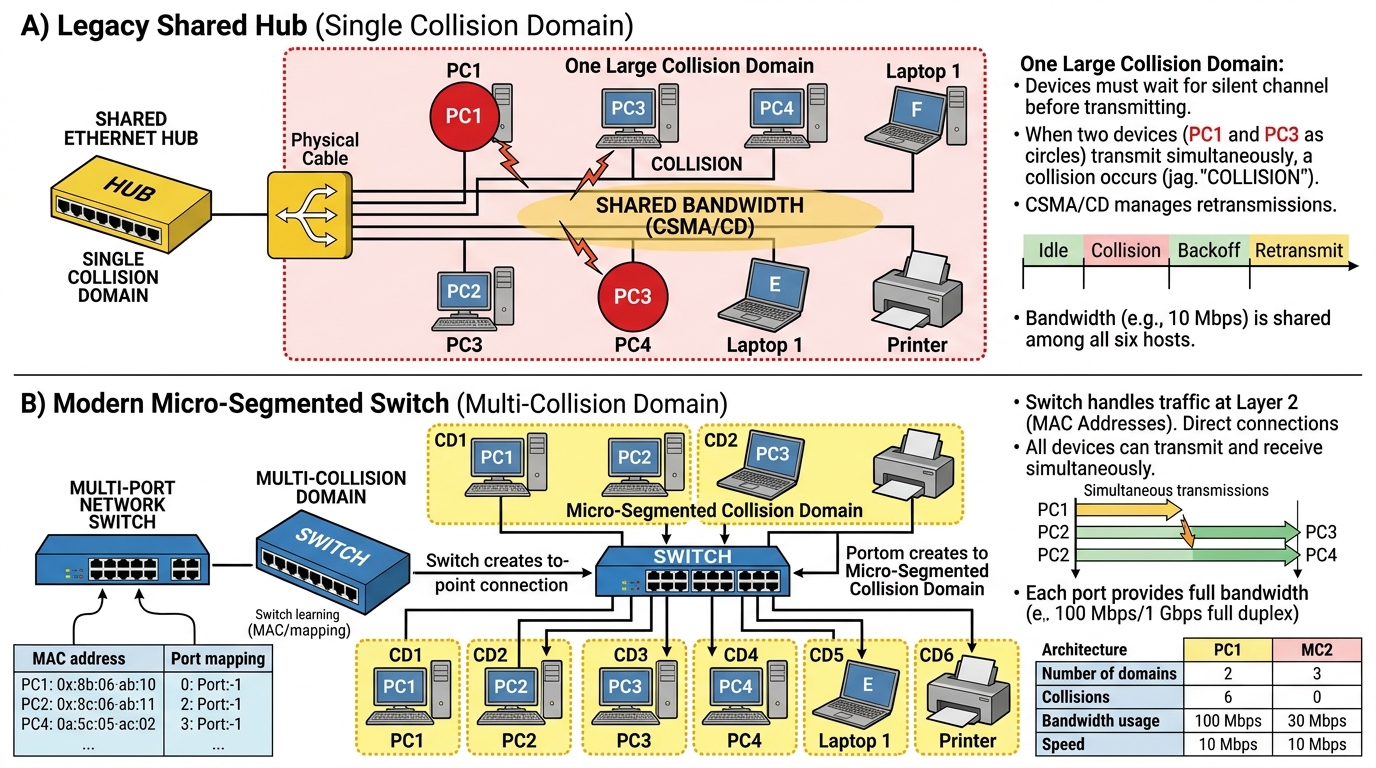
How Network Switches Reduce Collisions
Summary: Upgrading a basic hub-based network to a switch-based architecture significantly reduces collisions and latency. Unlike hubs that share bandwidth across a single collision domain, switches provide dedicated bandwidth to each connected device, preventing data packets from interfering with one another and maximizing overall network speed and reliability.
The Problem: Network Traffic and Hub Limitations
In the most basic type of local area network found today, nodes are simply connected together using hubs. As a network grows and user demands increase, there are several potential problems with this legacy configuration:
- Scalability - In a hub network, limited shared bandwidth makes it difficult to accommodate significant growth without sacrificing performance. Modern applications require more bandwidth than ever before. Quite often, the entire network topology must be redesigned periodically to accommodate growth.
- Latency - Latency is the amount of time that it takes a network data packet to get to its final destination. Since each node in a hub-based network has to wait for an opportunity to transmit in order to avoid network collisions, the latency can increase significantly as you add more connected nodes. If someone is transmitting a large file across the network, all of the other nodes have to wait for an opportunity to send their own data packets. You have probably seen this before at work: you try to access a local server or the internet, and suddenly everything slows down to a crawl.
- Network Failure - In a typical hub-based network, one malfunctioning device on a hub can cause widespread problems for other devices attached to the same hub due to incorrect speed settings (such as 100 Mbps on a 10-Mbps hub) or excessive broadcast storms. Switches can be configured to dynamically limit broadcast levels and isolate faults.
- Collisions - Ethernet uses a protocol called CSMA/CD (Carrier Sense Multiple Access with Collision Detection) to communicate across the network. Under CSMA/CD, a node will not send out a packet unless the network is clear of traffic. If two nodes send out packets at exactly the same time, a data collision occurs and the packets are lost. Then, both nodes wait a random amount of time before they retransmit the packets. Any part of the network where there is a possibility that packets from two or more nodes will interfere with each other is considered to be part of the same collision domain. A network with a large number of nodes on the same segment will often experience a high volume of collisions, creating a massive collision domain that stifles performance.
While hubs provide an inexpensive and easy way to scale up and shorten the distance that the packets must travel to get from one node to another, they do not break up the actual network into discrete, independent segments. That is exactly where network switches come in.
The Solution: Adding Network Switches
Think of a basic network hub as a busy four-way intersection where everyone has to stop. If more than one car reaches the intersection at the same time, they have to wait for their turn to proceed.
Now imagine what this scenario would be like with a dozen or even a hundred roads intersecting at a single point. The amount of waiting and the potential for a collision increases significantly. But wouldn't it be amazing if you could take an exit ramp from any one of those roads to the road of your choosing? That is exactly what a hardware switch does for network traffic. A switch is like a modern cloverleaf intersection—each car can take an exit ramp to get to its destination without having to stop and wait for other traffic to go by.
A vital difference between a hub and a switch is that all the nodes connected to a hub share the bandwidth among themselves, while a device connected to a switch port has the full bandwidth all to itself. For example, if 10 nodes are communicating using a hub on a 10-Mbps network, then each node may only get a tiny fraction of the 10 Mbps if other nodes on the hub want to communicate as well. But with a network switch, each node could possibly communicate at the full 10 Mbps simultaneously. Think about our road analogy. If all of the traffic is coming to a common intersection, then each car has to share that intersection with every other car. But a dedicated cloverleaf allows all of the traffic to continue at full speed from one road directly to the next.
Frequently Asked Questions (FAQ)
What is a collision domain in networking?
A collision domain is a network segment where data packets can collide with one another when being sent on a shared medium, particularly when using early hub devices. When a collision occurs, packets are dropped and must be retransmitted, which reduces overall network efficiency.
How exactly do network switches reduce collisions?
Network switches reduce collisions by creating a separate collision domain for each individual switch port. By analyzing MAC addresses, a switch forwards data packets only to the specific port connected to the intended destination device, rather than broadcasting the packet to all ports like a hub does. This eliminates the chance of packets interfering with each other.
Is it better to use a hub or a switch for a local area network?
It is vastly superior to use a network switch rather than a hub for a local area network. Switches provide dedicated bandwidth to every connected device, lower network latency, improve security by isolating traffic, and virtually eliminate the data collisions that plague hub-based networks.
What is the difference between CSMA/CD and modern full-duplex switching?
CSMA/CD is a protocol required in half-duplex shared-medium networks (like those using hubs) to detect and recover from collisions. In a modern full-duplex switched network, collisions are fundamentally impossible because each node has dedicated transmit and receive channels communicating directly with the switch port, rendering the CSMA/CD collision detection mechanism unnecessary.