Los Angeles Small Networks engineers and deploys air-gapped, on-premises Legal AI & Private RAG (Retrieval-Augmented Generation) Appliances for law firms across Century City, Downtown Los Angeles, Beverly Hills, Santa Monica, and Irvine. Our dedicated bare-metal hardware systems ingest your firm's entire proprietary document corpus—NetDocuments, iManage Work, Bates-stamped discovery, deposition transcripts, and decades of confidential work product—running state-of-the-art neural reasoning models entirely within your physical office with zero cloud data egress, zero privilege waiver risk, and court-ready pin-cite verification pipelines.
The Legal AI Paradox: Why Law Firms Cannot Use Public Cloud AI
Law firms operate under the most document-intensive cognitive demands in the modern economy. A single complex litigation matter or cross-border merger routinely produces hundreds of thousands of Bates-stamped documents, hundreds of hours of deposition testimony, and thousands of pages of judicial motions and contracts. Associates and paralegals expend thousands of non-billable or heavily written-down hours manually searching, reviewing, and synthesizing these massive corpora.
Yet, while commercial generative AI promises radical acceleration, law firms are ethically, contractually, and legally prohibited from feeding privileged client materials into multi-tenant commercial cloud services such as OpenAI, Anthropic, or public Microsoft Copilot. Doing so introduces catastrophic malpractice and evidentiary hazards:
Evidentiary Privilege Waiver Risks (FRE 502 & Cal. Evid. Code § 912)
Transmitting privileged communications, attorney work product, or confidential settlement terms across third-party commercial cloud APIs creates severe exposure to subject-matter privilege waiver challenges by opposing counsel.
Ethical Confidentiality Mandates (ABA Model Rule 1.6 & Cal. Bar Op. 2020-203)
State ethics rules require attorneys to maintain competent cybersecurity measures. Cloud Terms of Service that reserve telemetry rights, store session logs, or maintain third-party inspection privileges directly violate non-delegable duties of confidentiality.
Protective Orders & Client M&A Non-Disclosure Agreements
Court-ordered protective orders and corporate transaction NDAs strictly forbid disclosing covered discovery materials or financial disclosures outside specified defense teams. Uploading such documents to cloud AI vendors constitutes contempt of court and material breach of contract.
Judicial Sanctions for AI Hallucinations (The Mata v. Avianca Hazard)
Commercial models generate confident, fluent citations to fictitious judicial opinions, nonexistent appellate precedents, and inverted contract terms. In court proceedings, submitting unverified AI output leads to career-ending sanctions under Rule 11.
The Solution: Deploying dedicated, air-gapped on-premises GPU appliances directly within your firm's private server rack or secure on-site telecom room, eliminating cloud egress entirely while providing enterprise-grade neural search and synthesis.
The Institutional Data Moat: Why Law Firm Archives are the Legal MLS
In 2006, digital platforms like Zillow and Redfin launched with the public prediction that the internet would eliminate real estate brokers by publishing all listing data online. Yet by 2024, the National Association of Realtors (NAR) had grown to over 1.55 million members—more than existed prior to the internet era.
Why did technology fail to displace the broker? Because the Multiple Listing Service (MLS) was an institutional proprietary data layer owned and controlled exclusively by local broker boards. The tech platforms could not bypass the institutional data layer; they had to license it and operate subservient to it. The institutional data moat remained impenetrable.
Inside a premier law firm, your 20-to-30-year repository of past pleadings, winning motions in limine, proprietary deposition cross-examination outlines, confidential settlement agreements, and specialized transaction deal sheets is your firm's proprietary institutional data moat. Commercial foundation models have zero access to this repository. Transmitting it to public cloud models forfeits your competitive advantage. Our on-premises RAG appliances index and weaponize your historical work product behind your private firewall—allowing your attorneys to query the collective institutional wisdom of your entire firm in sub-second latency.
Court-Ready Pin-Cite Verification Engine
Unlike commercial chatbots that synthesize responses from probabilistic memory, our on-premises legal RAG pipeline enforces a strict, deterministic Multi-Stage Citation Verification Engine designed to withstand rigorous cross-examination and judicial scrutiny:
How Pin-Cite Verification Operates
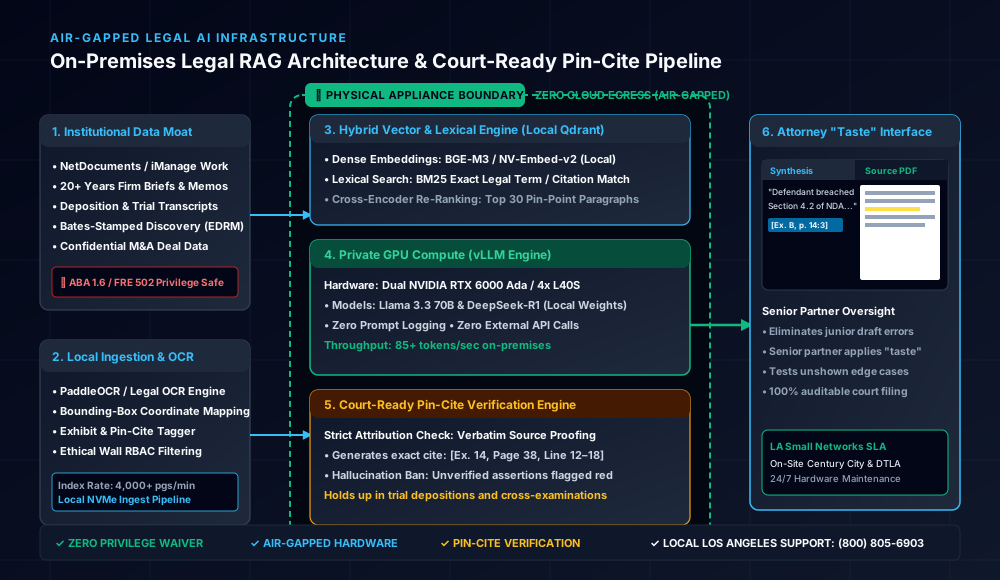
- Bounding-Box Document Ingestion: Scanned pleadings, Bates-stamped exhibits, and trial transcripts are parsed using local OCR engines that record the exact pixel coordinates, page numbers, line numbers, and exhibit stamps for every token.
- Hybrid Dense & Lexical Search: Dense neural vector embeddings (BGE-M3 / NV-Embed) capture semantic legal intent, while BM25 exact lexical matching pinpoints specific statutory codes, case names, and Bates numbers.
- Verbatim Source Proofing: When the local reasoning engine (Llama 3.3 70B / DeepSeek-R1) constructs an argument, it is constrained to extract verbatim excerpts with immutable pin-cites:
[Ex. 42 at p. 18:4–12; Bates #D-004821]. - Split-Pane Visual Verification: Attorneys click any citation in the synthesis pane to instantly bring up the highlighted original scanned PDF page side-by-side, confirming every factual assertion in seconds before signing a brief.
- Automated Hallucination Purge: Any synthesized statement that cannot be corroborated against the local document corpus with mathematical certainty is flagged in red and excluded from court-ready output.
"Taste" Over Automation: Amplifying Senior Partner Judgment
Recent economic productivity studies across cognitive professions reveal a crucial pattern: generative AI assistants improve average worker speed by approximately 14%, but the gains concentrate heavily in junior, mechanical, formulaic tasks. High performers and domain masters see the smallest percentage gains because generic models lack what seasoned attorneys call "taste".
In legal practice, "taste" is the ability to know:
- Which questions are worth asking: Framing the decisive legal issue rather than summarizing irrelevant peripheral facts.
- What judicial quality looks like: Understanding how a specific Los Angeles Superior Court or 9th Circuit judge evaluates evidentiary objections and procedural motions.
- When to reject superficially fluent output: The failure mode of 2026 AI is not that drafts appear broken; it is that drafts look exceptionally plausible, but fail under conditions the model was never shown.
Our on-premises RAG appliances do not attempt to replace partner judgment. Instead, they operate as a zero-latency cognitive force multiplier for senior partner taste, enabling your most experienced attorneys to instantly test strategies against 500,000 pages of internal records without relying on unchecked junior summaries.
Air-Gapped Appliance Architecture
The following diagram illustrates the zero-egress hardware topology, local vector database integration, and court-ready pin-cite verification pipeline deployed directly inside your office network:
Enterprise Hardware Specifications & Appliance Sizing
Los Angeles Small Networks provisions, tests, and deploys high-availability physical compute appliances engineered specifically for transformer-based inference and high-throughput vector indexing:
| Specification | Practice Group Appliance (5–25 Attorneys) | Enterprise Firm Appliance (25–150+ Attorneys) |
|---|---|---|
| Form Factor | Whisper-Quiet Tower / 4U Dedicated Rack Unit | 4U Heavy-Duty Rackmount Server Chassis |
| Neural Acceleration | 2x NVIDIA RTX 6000 Ada (96GB ECC VRAM) or Dual RTX 5090 | 4x NVIDIA L40S (192GB VRAM) / Dual H100 NVL |
| Host Compute & RAM | AMD EPYC 9354 (32 Cores) / 128GB DDR5 ECC RAM | Dual AMD EPYC 9654 (192 Cores) / 512GB DDR5 Registered ECC |
| Storage Fabric | 8TB PCIe 5.0 NVMe RAID 10 (12,000 MB/s sustained) | 32TB Enterprise U.3 NVMe RAID 10 (Hot-Swappable) |
| Local Model Stack | Llama 3.3 70B (AWQ Quantized), BGE-M3 Embeddings | DeepSeek-R1 Full Precision / Qwen 2.5 72B / Mistral Large |
| Inference Engine | vLLM with PagedAttention & TensorRT-LLM Acceleration | Distributed vLLM Cluster with Zero-Wait Context Switching |
| Ingestion Throughput | Up to 3,500 scanned PDF / OCR pages per minute | Up to 15,000 scanned PDF / OCR pages per minute |
| Network Security | Dual 10GbE SFP+ / Fortinet FortiGate ZTNA Isolated VLAN | Redundant 25GbE Optical Uplinks with Zero WAN Outbound Egress |
Document Management System (DMS) & Ethical Wall Security
Our on-premises systems integrate seamlessly with your existing legal software ecosystem without requiring workflow restructuring or third-party cloud data migration:
Native Connectors for Legal DMS Platforms
Turnkey, read-only connectors for NetDocuments, iManage Work 10, Worldox, OpenText, and Relativity e-Discovery export volumes. Real-time incremental synchronization captures new filings and amendments automatically.
Active Directory & Ethical Wall Enforcement
Integrates directly with Active Directory, Azure AD/Entra ID, and LDAP. The vector database enforces strict matter-level security: attorneys cannot query or view synthesized insights from matters where ethical walls or conflict screens are active.
Physical Air-Gap & Zero-Egress Network Rules
Configured with Fortinet Next-Generation Firewalls with ingress-only maintenance channels. Outbound internet egress from the neural inference nodes is physically and logically blocked. No client data, prompts, or model weights ever communicate over the public internet.
Managed Deployment Lifecycle & Los Angeles SLA
Los Angeles Small Networks provides turnkey white-glove engineering, on-site hardware deployment, and continuous lifecycle maintenance across Greater Los Angeles:
- Phase 1: Initial Discovery & Mutual NDA Execution: We audit your firm's document volume, DMS architecture, practice group security requirements, and server room physical space under strict confidentiality.
- Phase 2: Hardware Provisioning & Lab Burn-In: Hardware is built, burn-tested under full thermal GPU load, and preloaded with hardened Linux kernels and neural weights in our Los Angeles testing facility.
- Phase 3: On-Site Rack Installation & Network Hardening: Our senior network engineers rack and cable the appliance at your Century City, Downtown LA, or Beverly Hills office, establishing isolated VLANs and firewall policies.
- Phase 4: Document Ingestion & OCR Indexing: Initial bulk indexing of historical briefs, discovery files, and litigation folders into the high-speed vector repository.
- Phase 5: Partner Calibration & Citation Stress Testing: Practice group leaders test synthetic queries against real-world past cases, calibrating pin-cite thresholds and citation confidence scores.
- Phase 6: Continuous SLA, Model Updates & Hardware Support: 24/7 on-site hardware replacement guarantee, periodic local fine-tuning weight updates, and quarterly security audits.
Frequently Asked Questions (FAQ)
How does an on-premises RAG system prevent waiver of attorney-client privilege?
Under Federal Rule of Evidence 502 and California Evidence Code § 912, privilege is waived when confidential communications are disclosed to third parties without statutory protection. Because our on-premises appliances run entirely within your firm's physical office on local hardware with zero external internet egress, no third party ever receives your data. The legal status of your documents remains identical to paper files stored in your firm's private locked filing cabinets.
How does the citation verification engine eliminate AI hallucinations?
Our pipeline utilizes deterministic retrieval constraints. The neural model is prohibited from synthesizing any factual claim or legal interpretation without attributing it to an exact Bates number, exhibit identifier, page, and line number present in the ingested record. Attorneys can click any citation in the interface to view the original highlighted PDF page side-by-side, guaranteeing that every citation submitted to court is 100% verified.
Can conflicted practice groups access each other's cases through the AI?
No. Our vector retrieval system synchronizes with your firm's Active Directory and DMS access control lists (ACLs). When an attorney queries the system, the vector search engine applies a real-time pre-filter that restricts retrieval strictly to matters where that attorney has explicit authorization. Ethical walls, conflict screens, and sealed matter protections are mathematically enforced at the database layer.
What physical space, cooling, and power do these appliances require?
For boutique litigation firms (5–25 attorneys), our Practice Group Appliance is housed in a whisper-quiet tower workstation that plugs into a standard 120V 15A or 20A circuit in an air-conditioned office or telecom closet. For larger firms, our 4U rackmount enterprise appliance installs into standard 19-inch server racks with 208V/240V redundant power supplies and requires approximately 1,600W to 2,800W under peak GPU load.
How are open-weights legal models updated as new AI breakthroughs occur?
As leading open-weights models (such as Llama 3.3, DeepSeek-R1, and specialized legal foundation weights) release new revisions, Los Angeles Small Networks engineers perform cryptographically signed, offline firmware and model weight updates during scheduled maintenance windows, ensuring your firm always maintains frontier AI capabilities without sacrificing security.
Schedule a Confidential On-Site Consultation & Hardware Demonstration
Protect your clients' privilege, weaponize your institutional data moat, and equip your partners with court-auditable neural intelligence. Contact our senior network engineering directors to schedule a private, on-site demonstration at your Los Angeles office.
Direct Engineering Consultation
Serving Downtown Los Angeles, Century City, Beverly Hills, Santa Monica, and Irvine legal practices.