Networking Topologies
Featured Snippet Summary: Networking topologies define the structural layout of a computer network. The most common types include bus, ring, star, and hybrid topologies like the star bus network. Each topology handles data transmission, node connection, and backbone routing differently to optimize local infrastructure.
Common Types of Network Topologies
Understanding the fundamental networking topologies is essential for designing an efficient and scalable IT infrastructure. Below, we explore the most common layouts used in modern environments.
Bus Network Topology
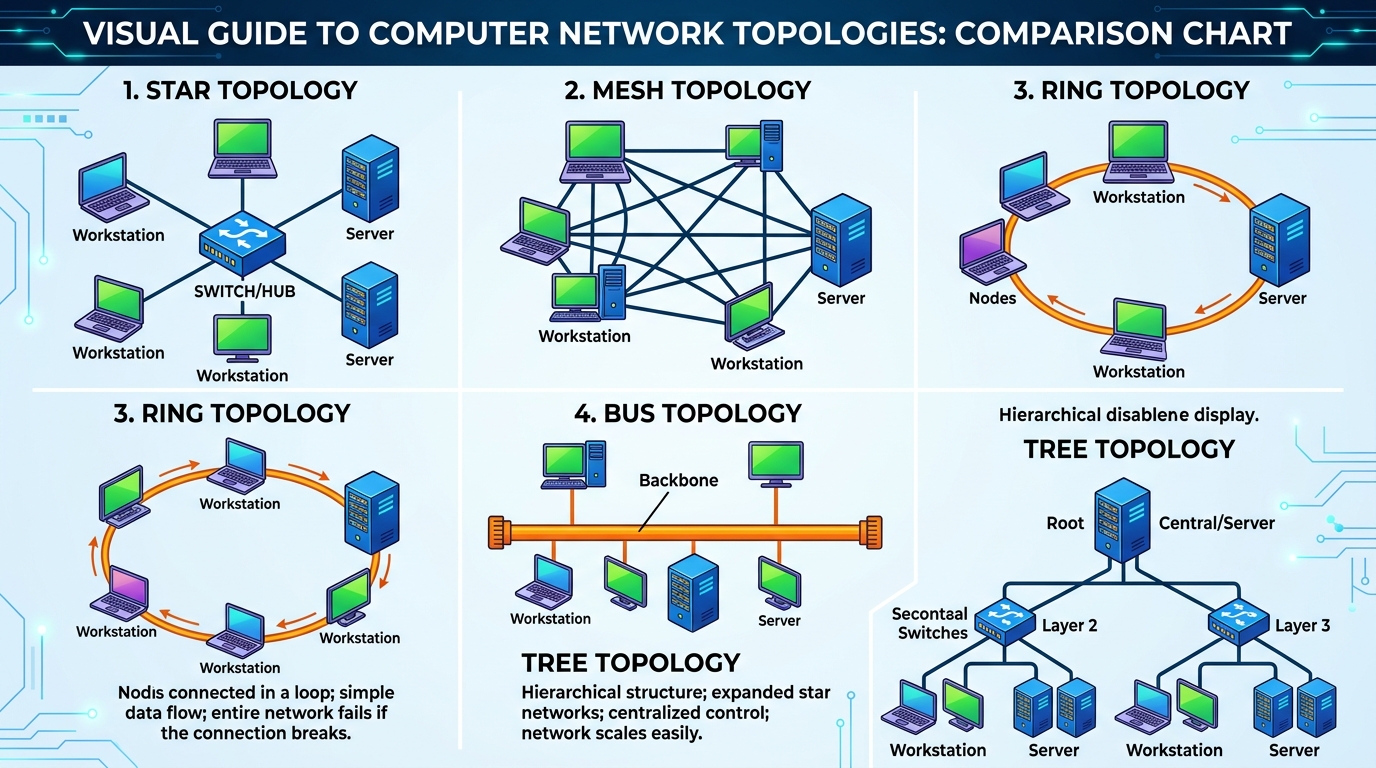
In a bus network topology, each node is daisy-chained (connected one right after the other) along the same backbone, similar to Christmas lights. Information sent from a node travels along the backbone until it reaches its destination node.
Each end of a bus network must be terminated with a resistor to keep the signal that is sent by a node across the network from bouncing back when it reaches the end of the cable.
|
Bus network topology |
Ring Network Topology
Like a bus network, ring network topologies have the nodes daisy-chained. The primary difference is that the end of the network comes back around to the first node, creating a complete circuit.
In a ring network, each node takes a turn sending and receiving information through the use of a token. The token, along with any data, is sent from the first node to the second node, which extracts the data addressed to it and adds any data it wishes to send. Then, the second node passes the token and data to the third node, and so on until it comes back around to the first node again. Only the node with the token is allowed to send data. All other nodes must wait for the token to come to them.
|
Ring network topology |
Star Network Topology
In a star network topology, each node is connected to a central device called a hub or switch. The central hub takes a signal that comes from any node and passes it along to all the other nodes in the network.
A hub does not perform any type of filtering or routing of the data. It is simply a junction that joins all the different nodes together, making it easy to isolate failures without affecting the entire network.
|
Star network topology |
Star Bus (Hybrid) Network Topology
Probably the most common network topology in use today, the star bus network combines elements of the star and bus topologies to create a versatile network environment.
Nodes in particular areas are connected to hubs (creating stars), and the hubs are connected together along the network backbone (like a bus network). Quite often, stars are nested within stars, which provides exceptional scalability for large-scale IT environments.
|
A typical star bus network |
Frequently Asked Questions
What is a bus network topology?
A bus network topology is a network architecture where each node is daisy-chained along the same backbone cable. Data travels along the backbone until it reaches its destination, requiring terminators at both ends to prevent signal bounce.
How does a ring network topology differ from a bus topology?
Unlike a bus network, a ring network connects the last node back to the first node, creating a complete circuit. Data transmission is managed through a token, which is passed from node to node to ensure orderly communication without data collisions.
Why is the star bus topology so common?
The star bus topology combines the reliability of a star network with the scalability of a bus network. By connecting central hubs along a main backbone, it provides a highly versatile and resilient local infrastructure, allowing easy expansion and isolated troubleshooting.