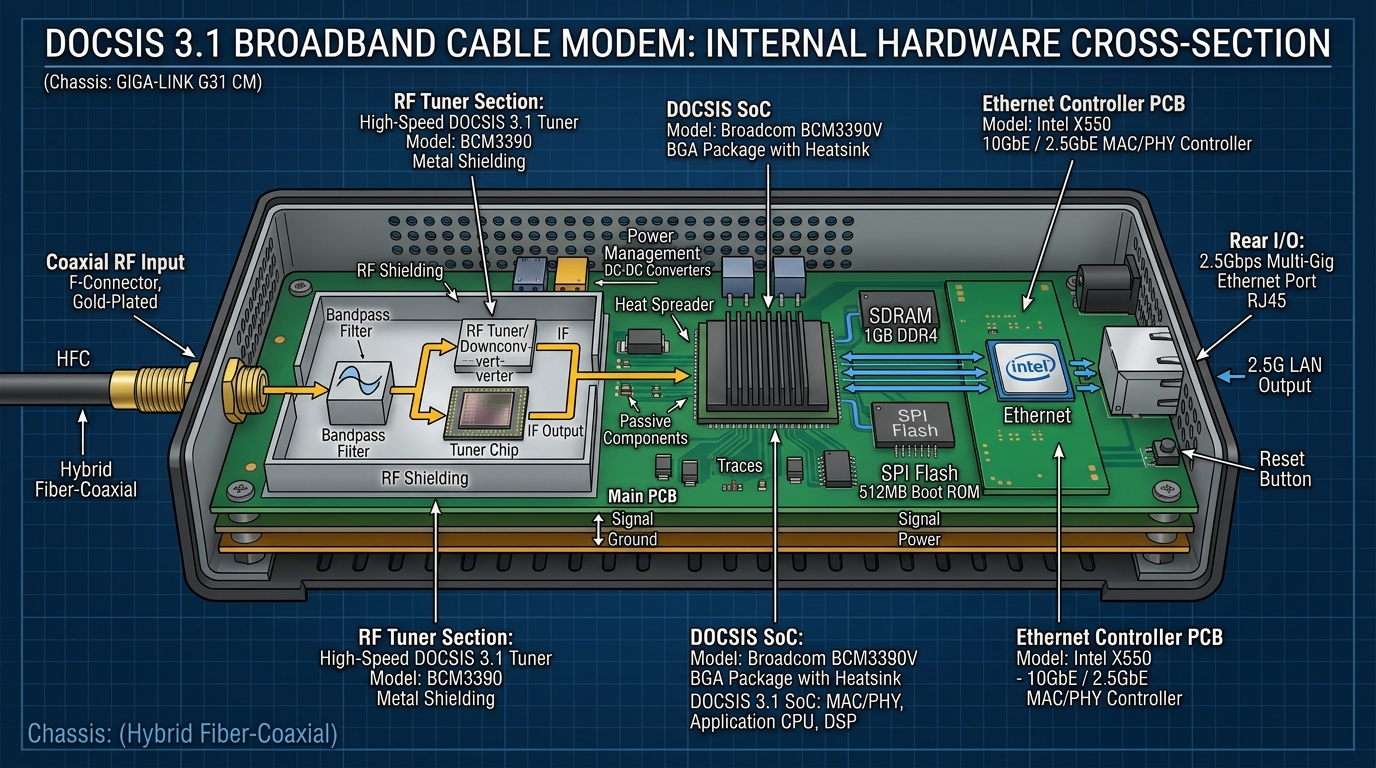
What is inside a cable modem? A cable modem typically consists of five primary internal components that work together to provide high-speed internet access. These include a tuner to receive the signal, a demodulator to convert analog signals to digital data, a modulator for outbound transmission, a media access control (MAC) device to interface with the network, and a microprocessor that acts as the central brain orchestrating these tasks.
Understanding How Cable Modems Connect You to the Internet
Cable modems can be either internal or external to the computer, though external standalone units are the modern standard. In some cases, the cable modem can be part of a set-top cable box, requiring that only a keyboard, mouse, or router be added for full Internet access. In fact, if your local cable system has upgraded to digital cable, the advanced set-top box the cable company provides will likely be capable of connecting directly to the Internet, whether or not you formally receive Internet access through your CATV connection.
Regardless of their outward appearance or form factor, all consumer and enterprise cable modems contain certain key components essential for data processing:
- A tuner: Receives the modulated radio frequency signals from the coaxial cable.
- A demodulator: Converts the incoming analog signal into a digital data stream that your computer can understand.
- A modulator: Takes outgoing digital data from your computer and converts it into analog signals for transmission back to the cable company.
- A media access control (MAC) device: Acts as the interface between the hardware and the network, directing data packets effectively.
- A microprocessor: Serves as the main control unit, managing all internal operations and traffic flow.
Pros and Cons of Cable Internet Connections
Understanding the advantages and disadvantages of broadband cable is critical for network engineering. If you are one of the first users to connect to the Internet through a particular cable channel in your neighborhood, then you may have nearly the entire bandwidth of the channel available for your exclusive use. This results in incredibly fast download and upload speeds.
However, as new users—especially heavy-access users who stream video or download large files—are connected to the same local channel node, you will have to share that bandwidth. Consequently, you may see your performance degrade as a result of network congestion. It is quite possible that, in times of heavy usage with many connected users simultaneously active, your actual performance will fall far below the theoretical maximums advertised by your Internet Service Provider (ISP). The good news is that this particular performance issue can usually be resolved by the cable company physically upgrading the infrastructure, adding a new channel, and splitting the base of users across multiple nodes to balance the load.
Performance Advantages Over ADSL
Another major benefit of using a cable modem for Internet access is that, unlike older ADSL technology, its performance doesn't directly depend on your physical distance from the central cable office. Traditional ADSL signals severely degrade the further you get from the telecom exchange.
In contrast, a digital CATV system is explicitly designed to provide digital signals at a consistently high quality to all customer households within the network footprint. On the upstream side, the burst modulator integrated into modern cable modems is intelligently programmed with the precise distance from the head-end facility. It automatically provides the proper signal strength required for accurate, high-speed transmission, ensuring that users at the edge of the network receive the same robust connectivity as those closer to the source.
The Role of DOCSIS Standards in Modern Cable Modems
To ensure interoperability and consistent performance across different hardware manufacturers and Internet Service Providers, the cable industry relies on a suite of specifications known as DOCSIS (Data Over Cable Service Interface Specification). Originally introduced in the late 1990s, DOCSIS has evolved through several iterations to support increasingly faster data transfer rates.
Modern cable modems typically support DOCSIS 3.0 or DOCSIS 3.1. These advanced standards utilize a technology called channel bonding, which allows the modem to combine multiple downstream and upstream channels simultaneously. By aggregating these channels, DOCSIS 3.1 modems can achieve multi-gigabit download speeds, significantly reducing latency and improving the overall user experience during data-intensive tasks like online gaming and 4K video streaming. Understanding the DOCSIS version your modem supports is essential for maximizing your internet plan's potential.
Frequently Asked Questions
What are the core components inside a cable modem?
Every cable modem contains five key components: a tuner, a demodulator, a modulator, a media access control (MAC) device, and a microprocessor. Together, these parts receive, convert, and manage data signals from the internet to your local computer or network router.
How does cable internet bandwidth sharing work?
Cable internet operates on a shared channel system. When you connect, you share the total channel bandwidth with other users in your local neighborhood node. During peak hours, heavy usage by multiple users can cause performance to temporarily degrade until the provider splits the node.
Does distance affect cable modem performance like ADSL?
Unlike ADSL, a cable modem's performance does not depend on the physical distance from the central office. Digital CATV systems use burst modulators programmed to adjust signal strength based on distance, ensuring accurate transmission across the entire network.