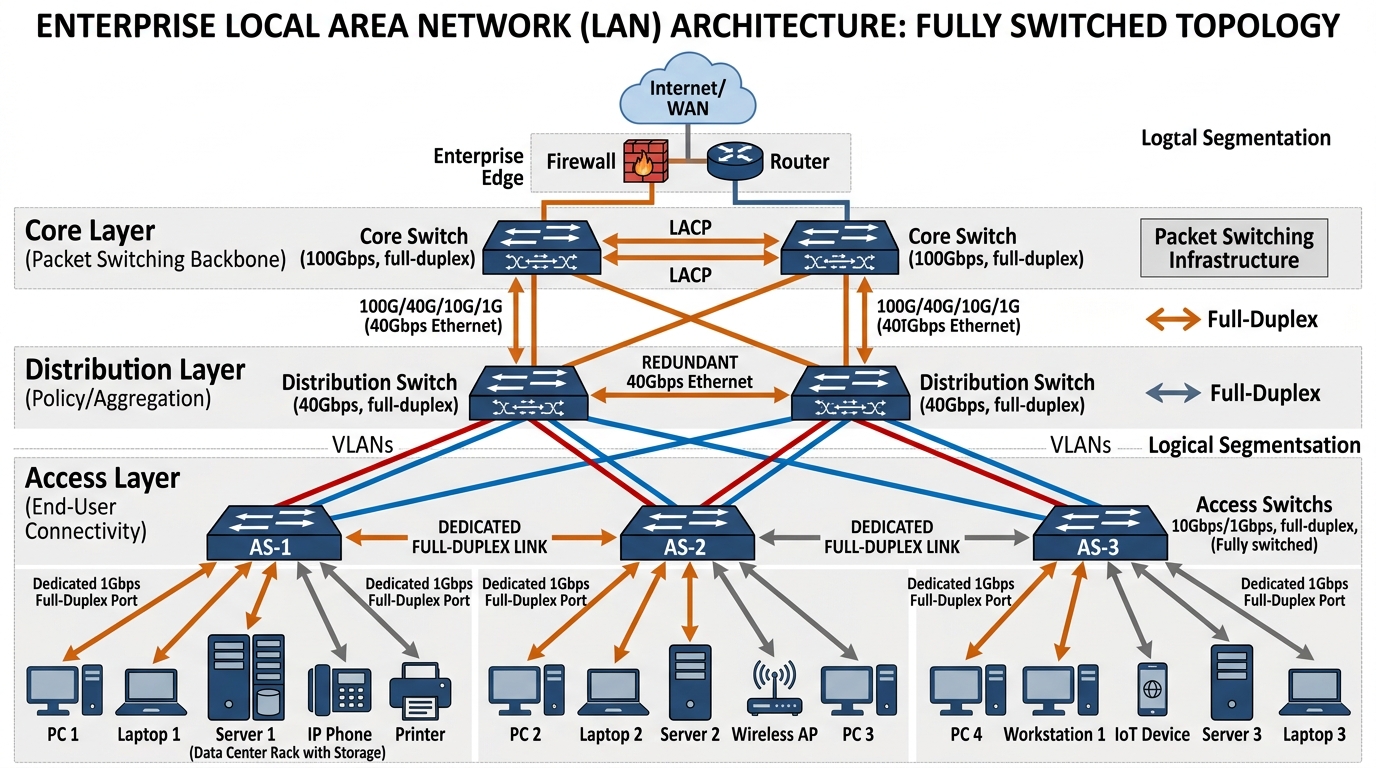
Fully Switched Networks are designed to optimize data transmission across enterprise environments. In a fully switched network, network switches replace all the traditional hubs of an Ethernet network by providing a dedicated segment for every individual node. These segments connect directly to a switch, which supports multiple dedicated segments (sometimes scaling into the hundreds).
Since the only devices on each segment are the switch and the node, the switch picks up every transmission before it reaches another node. The switch then forwards the frame over the appropriate segment. Because any segment contains only a single node, the frame only reaches the intended recipient. This microsegmentation allows many conversations to occur simultaneously on a switched network, significantly reducing network congestion and preventing packet collisions.
Enabling Full-Duplex Ethernet
One of the primary advantages is that switching allows a network to maintain full-duplex Ethernet. Before the widespread adoption of switching, traditional Ethernet was half-duplex, which means that data could be transmitted in only one direction at a time. In a fully switched network, each node communicates only with the switch, not directly with other nodes. Information can travel from node to switch and from switch to node simultaneously.
Fully switched networks employ either twisted-pair or fiber-optic cabling, both of which use separate conductors for sending and receiving data. In this type of environment, Ethernet nodes can forgo the traditional collision detection process (CSMA/CD) and transmit at will, since they are the only potential devices that can access the medium. In other words, traffic flowing in each direction has a lane to itself. This allows nodes to transmit to the switch as the switch transmits to them—creating a completely collision-free environment.
Transmitting in both directions can effectively double the apparent speed of the network when two nodes are exchanging information. For example, if the baseline speed of the network is 10 Mbps, then each node can transmit simultaneously at 10 Mbps, achieving a theoretical throughput of 20 Mbps per port.
Benefits of Microsegmentation
Microsegmentation is a key benefit provided by fully switched networks. By breaking down a larger collision domain into smaller, isolated segments, the network ensures that individual nodes do not compete for bandwidth. This architectural shift significantly improves security, as data packets are no longer broadcasted across the entire network, preventing unauthorized packet sniffing on adjacent nodes.
Furthermore, microsegmentation simplifies network troubleshooting and enhances overall reliability. If a specific node experiences hardware failure or generates excessive broadcast traffic, the issue is isolated to its dedicated segment rather than degrading the performance of the entire local area network (LAN).
The Role of VLANs in Modern Switched Networks
In addition to basic microsegmentation, contemporary fully switched networks heavily leverage Virtual Local Area Networks (VLANs). VLANs allow network administrators to logically segment a single physical switch into multiple isolated broadcast domains. This logical division operates independently of the physical location of the nodes, meaning that devices on different floors or even different buildings can share the same VLAN as long as they are connected to the same switching infrastructure.
Implementing VLANs enhances network security by restricting communication between different departments. For example, the finance department's traffic can be entirely isolated from the guest Wi-Fi network, ensuring that sensitive data is protected. Moreover, VLANs reduce unnecessary broadcast traffic, which conserves bandwidth and decreases latency across the enterprise environment. The combination of full-duplex Ethernet and VLAN technology forms the foundation of modern, highly scalable corporate networks.
Performance Metrics and Latency Reductions
Transitioning to a fully switched architecture dramatically reduces network latency. In legacy hub-based topologies, every node received every transmission, causing significant delays and frequent collisions as network traffic scaled. A switch dynamically builds a MAC address table, enabling it to map physical hardware addresses to specific switch ports. This allows the switch to make intelligent, high-speed forwarding decisions.
As a result, latency is often reduced to mere microseconds. This deterministic performance is critical for real-time applications such as Voice over IP (VoIP), video conferencing, and high-frequency trading platforms. By virtually eliminating the risk of collisions and providing dedicated bandwidth to each connection, a fully switched network easily accommodates the high-bandwidth demands of today's unified communications and cloud computing services.
Frequently Asked Questions
What is the difference between a hub and a switch?
A hub broadcasts all network traffic to every connected device, which can lead to data collisions and slower network speeds. A switch, however, creates a dedicated connection (or segment) for each device, forwarding data frames only to the intended recipient device. This microsegmentation improves security and overall network throughput.
Why are fully switched networks considered collision-free?
Fully switched networks are considered collision-free because each node has a dedicated segment connecting it directly to the switch, and they operate in full-duplex mode using separate conductors for transmitting and receiving data. Because no two devices share the same collision domain, data packets do not collide.
What cables are used in a fully switched network?
Fully switched networks typically employ twisted-pair copper cabling (such as Cat5e, Cat6, or Cat6a) or fiber-optic cabling. Both of these physical media types support separate paths for sending and receiving data, which is essential for full-duplex communication.